

Choosing the Optimal Cooling: Liquid vs. Air
As the demand for AI, cloud services, and other advancing technologies increases, the pressure on conventional cooling methods intensifies. According to Vertiv’s Data Center Trends 2025, AI factories might soon see average rack densities soar to 500-1000kW. This surge necessitates not only more power but also superior cooling solutions. Failing to implement efficient data center cooling could result in overheating, leading to costly and unexpected downtime.
While air cooling has been a reliable choice for numerous data centers, it sometimes falls short when managing high-density rack systems. Our liquid cooling solutions offer a robust alternative, ensuring efficient operation and minimizing the risk of overheating. Dive into this article to explore the distinctions between liquid and air cooling and determine the most suitable option for your facility.
Understanding Liquid and Air Cooling Mechanisms
Ensuring your data center is equipped with effective cooling systems is crucial for operational uptime. Devices in your facility generate heat that must be dissipated to avoid overheating and potential failures. Both air and liquid cooling methods are designed to address this, albeit in distinct manners. Air cooling utilizes air to collect and disperse heat, predominantly suitable for less dense setups. It often involves precision cooling systems that can be tailored to the specific needs of racks, rows, or entire rooms, such as the Liebert PDX Compact DX Cooling System or Liebert CW Chilled Water Cooling System.
The defining distinction between liquid and air cooling lies in their heat dissipation mediums. Liquid cooling circulates water or specialized nonconductive liquids around or through equipment. This fluid absorbs and reduces heat, readying it for reuse in the cooling cycle. Like air cooling, liquid cooling adopts three primary techniques:
- Direct-to-chip cooling: Delivers coolant directly to server chips. An example is the Vertiv CoolChip CDU.
- Rear door heat exchangers: Positioned at the back of server racks to extract expelled heat. An example is the Liebert DCD Water-Cooled Passive Rack Door.
- Immersion cooling: Submerges entire servers in nonconductive liquid to absorb heat directly.
These methods provide a more direct cooling strategy and can accommodate higher rack densities than traditional air cooling systems.
Selecting Your Ideal Data Center Cooling Solution
Choosing the best cooling solution for your data center is contingent on your specific rack density. For low-density racks under 20kW, air cooling is often adequate, as these racks generate less heat. Opting for a cost-effective air cooling method such as the Liebert DS Direct Expansion Cooling System can be beneficial.
However, for high-density racks consuming 20kW or more, liquid cooling becomes a viable consideration, and becomes essential at 30kW and above. The higher the power usage, the more heat is generated, necessitating liquid cooling due to its superior heat exchange capabilities. Integrating both air and liquid cooling can be the optimal choice to efficiently manage heat. The Vertiv CoolChip CDU embodies this hybrid strategy by delivering liquid directly to chips while maintaining an ambient room temperature.
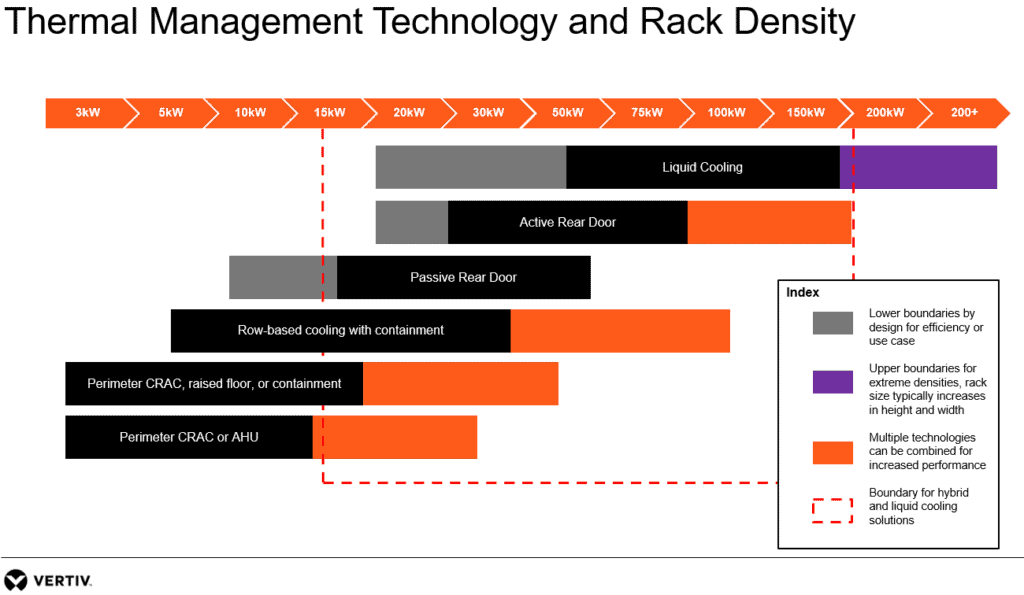
As innovations like AI drive the need for higher density servers, hybrid cooling is increasingly adopted to manage thermal loads effectively while controlling expenses. Many new products are designed to support this hybrid approach, allowing data centers to switch cooling techniques as necessary, thereby sustaining optimal operational temperatures with minimal energy consumption.
Interested in Optimizing Your Facility’s Cooling?
Enhancing your facility’s environment involves more than managing rack densities and temperatures. To ensure seamless operation of your critical equipment, maintaining a structured, secure, and state-of-the-art setup is key. Navigating the intricacies of optimizing your cooling infrastructure can be complex, especially with the rapid evolution of technology. Contact Air and Power Solutions at 954.427.0019 to explore tailored cooling solutions.
Frequently Asked Questions About Liquid Cooling
- What is the primary advantage of liquid cooling over air cooling? Liquid cooling can handle higher rack densities and dissipate more heat efficiently compared to air cooling.
- When should I consider switching to liquid cooling? If your data center racks operate above 20kW, liquid cooling should be considered, becoming crucial at 30kW or more.
- Can liquid cooling be combined with air cooling? Yes, a hybrid approach utilizing both methods can effectively manage heat while controlling costs.
- Is liquid cooling more energy-efficient than air cooling? Liquid cooling can be more energy-efficient, particularly in high-density environments, as it uses less energy to transfer heat.
- How does liquid cooling affect equipment longevity? By maintaining optimal temperatures, liquid cooling can potentially extend the lifespan of your equipment.