
Enhance Your Data Center Cooling: A Step-by-Step Guide
Balancing cost efficiency with environmental responsibility is a challenge many organizations face. The data center, however, offers a space where these objectives can be achieved simultaneously.
Research from the Uptime Institute highlights that data centers can account for up to 35% of energy consumption in non-manufacturing, information-rich enterprises. Yet, by adopting effective energy management strategies, data centers can substantially cut expenses and decrease their carbon emissions.
With the upward trend of energy costs and the increasing power requirements of data centers, efficient cooling solutions remain pivotal. By integrating effective practices, you can enhance your data center’s cooling performance and ensure it’s prepared for future demands.
1. Optimize Data Center Sealing
Properly sealing your data center is foundational to maximizing cooling efficiency. Unsealed areas can lead to cooling losses and increased humidity, both of which compromise cooling performance. To effectively seal your data center:
- Ensure doors remain closed consistently.
- Employ a vapor seal using materials like plastic film, vapor-resistant paint, and vinyl for walls and flooring to control the internal environment economically.
- Seal any gaps around pipes and cables where they enter the data center through walls and raised floors.
- Consider a comprehensive assessment to detect and address inadequately sealed areas.
2. Implement a Hot-Aisle/Cold-Aisle Configuration
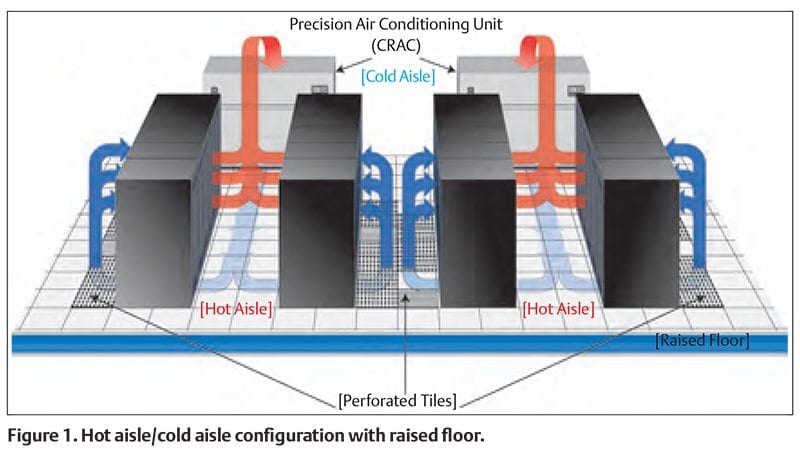 This system aims to maximize heat removal from equipment with minimal energy usage. It optimizes airflow and enhances the efficiency of computer room air conditioners (CRAC).
Racks are positioned to face each other, drawing cool air from cold aisles and venting hot air into hot aisles. Placing CRAC units perpendicular to hot aisles increases the return air temperature, boosting overall efficiency.
3. Utilize Aisle Containment Techniques
After setting up a hot-aisle/cold-aisle design, the next step is integrating aisle containment. This prevents mixing of hot and cold air, enhancing cooling efficiency. By using panels above and between racks, and installing doors at aisle ends, containment is achieved.
This straightforward and cost-effective method significantly raises the efficiency and capacity of cooling units, making it possible to handle higher heat loads. For additional insights, refer to our white paper “Focused Cooling Using Cold Aisle Containment”.
4. Leverage Intelligent Control Systems
Advanced control systems like the Liebert DSE optimize component operations and minimize energy use. Offering diagnostic integration with management systems, it is up to 70% more energy-efficient compared to other technologies.
The Liebert iCOM with Optimized Aisle Control allows independent operation of compressors and fans, tailored to IT load and airflow needs. This results in warmer air returning to the units, improving efficiency and reducing unnecessary cooling.
We’re Here to Support You
Data center managers face escalating energy demands, making efficient consumption critical. Implementing the straightforward strategies discussed can significantly reduce energy used for cooling, aiding in meeting sustainability targets.
Our team collaborates with you to tailor a plan that effectively lowers energy consumption. Many organizations can achieve notable reductions with minimal adjustments and investment. Reach out to your local Liebert partner to explore greener solutions today!
Stay informed with the latest in data center cooling technologies and strategies by signing up for the Air and Power Solutions newsletter today!
Data Center Cooling FAQ
What is the significance of sealing in data center cooling?
Proper sealing is critical as it prevents heat loss and humidity infiltration, both of which reduce cooling efficiency.
How does a hot-aisle/cold-aisle configuration work?
This setup improves air flow by separating hot and cold air streams, enhancing the efficiency of cooling systems.
What are the benefits of aisle containment?
Aisle containment prevents hot and cold air from mixing, increasing cooling capacity and energy efficiency.
Why are intelligent control systems important for data center cooling?
These systems optimize operations, minimize energy consumption, and improve the overall efficiency of the cooling infrastructure.